
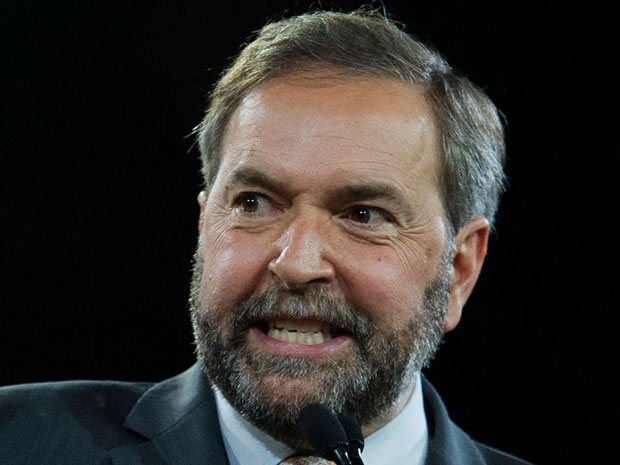
Canada’s centrist New Democratic Party (the NDP) has elected a new leader, Thomas Mulcair, following the premature passing of the previous incumbent, Jack Layton. Mulcair, who won through from a field of several candidates, is seen as a controversial choice by some journalists and commentators. Until relatively recently a member of the Liberal Party and generally considered more right-wing than the party has a whole (though that is debatable) the rivalry between Mulcair and his rivals was at times quiet bitter and a number of high-profile resignations have already taken place from within NDP ranks following his victory. On the other hand as a Québec-based candidate (with dual French and Canadian nationality) he seems best placed to build upon the party’s fragile electoral base. Though the NDP is a Canadian federalist group with grassroots support throughout the country, at the level of Canada’s federal parliament, the House of Commons, it is principally composed of MPs from Québec, a province where the party has little organisation and is heavily reliant on disaffected Québécois or Québec nationalist voters for support. It was the unexpected winning away of those voters from the nationalist Bloc Québécois (BQ) in the Canadian general election earlier this year that brought the NDP to national importance after a long history of being the also-rans of Canadian politics, giving it a slew of new MPs.
If the NDP wishes to remain as an active force in Canadian federal politics it needs to retain and expand its Québec vote. As it is, a number of recent polls have shown that the BQ’s provincial sister party, the Parti Québécois (PQ), which has traditionally governed Québec, seems set on achieving an electoral victory over its Liberal Party rivals in the province in the forthcoming May elections to form the next government in Quebec City. If that was to happen the presence of a Québécois “separatist” strain within the NDP may well come to the fore, allowing those sympathetic to the PQ’s aim of holding another referendum on independence for Québec to influence the party’s policies on the issue. The NDP has normally shied away from making its position clear on the controversial Canadian federal legislation that insists on a “clear majority” in favour of independence in any referendum vote held in Québec. Some local NDP members in fact continue to support the traditional democratic Québécois nationalist position of “50% plus 1” espoused, by amongst others, the BQ and PQ.
If the NDP, or a section of it, was perceived to be “unsound on the national question” (as we might say in Ireland), it might have fatal results for its electoral fortunes outside of Québec, especially in the party’s traditional heartlands in the west of the country. So Thomas Mulcair faces an uncomfortable balancing act between the electoral needs and self-interest of his own party, and the separate and at times competing demands of voters in Canada and Québec. But then he wouldn’t be the first Canadian politician to fall from a height when faced with that particular challenge.
One final question, though, for all my Québécois friends. Where are the Coalition Avenir Québec and the much-heralded brave new world of Québec politics? Neither federalist nor separatist, has the party’s identity crisis already doomed it?
Related articles
- Aboriginal Sensitivities (ansionnachfionn.com)
- Mulcair, Harper allies in plotting Liberals’ demise (cbc.ca)
- Yaffe: Harper hardly shaking in his boots over Mulcair (vancouversun.com)
- Hébert: Has Stephen Harper met his match? (thestar.com)
- Tim Harper: NDP Leader Thomas Mulcair returns to a tougher neighbourhood – Toronto Star (thestar.com)
 AN SIONNACH FIONN
Concerning the retirement of the separatist question… it’s a little like the old saying in Québec that “what is natural is like a horse, try to chase it away, it will come galloping right back.”
53% of Quebecers think independence will never happen…but…
45% prefer independence.
How parties interpret these results define politics in Québec today and influences Canadian politics.
Federal Level
Tories in power since May 2011 with over 50% support across Canada. In Québec NDP won. The Liberals (Trudeau’s old party, in scandal after scandal is still low across Canada.) Quebec chose NDP in May (switching from almost 20 years support of the Bloc because… 1. 20 years is a long time, 2. Jack Layton, sick, courageous and friendly was seen as an obvious choice, non threatening choice and opportunity to change for change sakes in Quebec.) The support for NDP has been dropping steadily since. The Bloc is now back at 31%, leading.
****To beat the tories (in 5 years or so…) the Liberals and NDP must merge (or one disappear) and … AND the NDP must keep (regain) its Quebec support.***
Mulcair. New NDP leader. Speaks English and French perfectly. Very pro-environment. But… started his career as legal advisor to English support group in Québec, waging legal guerilla warfare on Bill 101. *NOT* a separatist. Hence the surprise that they would get the backing of Quebec Solidaire, a pro-independence party.
Provincial politics:
The Coalition Avenir Québec (who wants to forget the separation issue and focus on “solving more urgent problems”) was doing great in the polls… until a month ago. Now, because they have tried to build a coalition of such different people, are accused of opportunism. Every week they suggest something new to improve society, but many people feel they are not genuine. Flash in the pan?
Parti Quebecois. After a trial by fire where Duceppe attempted (and failed) to take the leadership, Pauline Marois is back in control and seen as very tough. She has earned the nickname “dame de béton”, “concrete Lady”. The PQ is now up in the polls. Their problem right now is attracting young voters who feel the party is too cynical and corporatist. The strategy for independence: PQ favours independence and when the time comes, when it is the right time they will defend it and propose something. No referendum at this time.
The Liberals(provincial): going down in the polls after so many years in power, seen as corrupt, pressure for elections in 2012.
Quebec-Solidaire(left-left of center): from 10% to 8% in the polls. Is speaking of “joining forces” with the NDP. Quebec solidaire portrays itself as for independence. NDP is clearly a federalist party. Strategy for independence: Two years of a national discussion culminating in workgroups and negotiation in order to achieve something everyone can agree to.
Option nationale: 2% total transparency: the party I support. Pro Independence, Strategy: wants to achieve specific goals in the assembly first (100% income taxes, Signature of Kyoto, nationalisation of natural resources…), and then propose a referendum on total independence. Sort of a Devo-Max first then referendum. “On” is made up largely of ex-PQ members.
http://www.vigile.net/Take-a-Good-Look-Quebec-Could-Soon
Click to access Rapport_Sondage_AQMI_Quebec_vu_par_le_ROC_11mars2012.pdf
http://news.nationalpost.com/2012/03/12/bloc-quebecois-take-lead-over-ndp-in-latest-poll/
LikeLike