
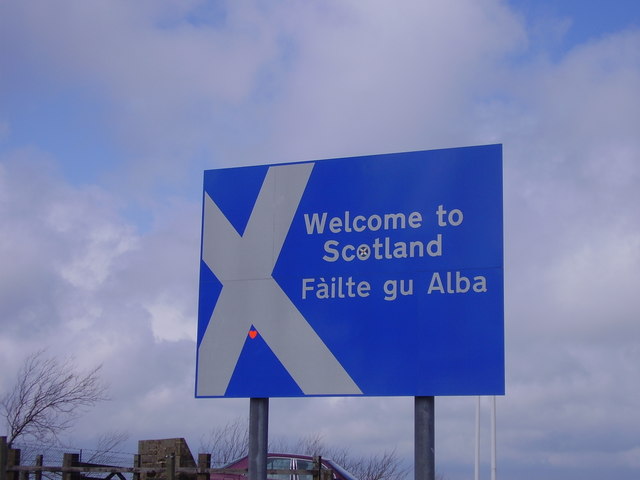
If you’re going to write a biased newspaper article it’s always best to put your bias right up there in the first few lines. Just look at this opening sentence from The Courier in Scotland:
“The staggering cost of imposing Gaelic culture on areas with no tradition has come under attack.”
“Staggering”? “Imposing”? Is this a case of reporting the news or shaping the news? Judge for yourself:
“Tens of millions of pounds will be spent across Scotland’s 32 local authority areas in the next few years to implement Gaelic language plans (GLPs).
They seek to safeguard the future of the declining language by promoting learning, increasing its use and enhancing its status.
That will be achieved through the gradual introduction of bilingual signs and websites, and the hiring of council officers with a remit for Gaelic matters.
The scheme has been many years in the making and, although supportive of the bid to preserve the country’s heritage, opponents have questioned the Government’s spending priorities at a time when councils are being forced to make significant cuts to services.”
How nice to be helpfully informed that those who oppose the Scottish government’s plans to protect and promote the rights of its Scottish-speaking citizens are still supportive of the “bid to preserve the country’s heritage”. So that is all right then. Are you reassured? Persuaded of their reasonable nature and the validity of their argument? No? Then read on, MacDuff.
“In Perth and Kinross — where the last native speaker of Perthshire Gaelic is said to have died 20 years ago — almost £350,000 is to be spent on the project.
Some communities, including that represented by Milnathort Community Council, have called on Perth and Kinross Council to divert the cash to areas of greater importance, such as roads maintenance.”
Ah the most famous word in journalism: “some”. Just ask our own Ruairí Quinn, the Minister of Education in Ireland. He can tell you all about the special applicability of “some” when targeting a particular community. Sure, it covers a multitude of sins.
“But with the council clear that it is tied to investing the cash in Gaelic measures by the Government, local councillor Willie Robertson — a lone voice of opposition when the local GLP was unveiled — has called for a rethink at a national level.”
So this “lone voice” would be the “some communities” then?
The editorial team at The Courier seem to have made up their mind about the issue of language rights in Scotland and the recognition of the nation’s bilingual heritage. In Robertson’s words:
“There will no doubt be places in Kinross-shire that have names that draw their origins from Gaelic but I don’t ever remember that the language was spoken here.”
And some wish it to remain that way.
 AN SIONNACH FIONN
The media in Scotland is pathetic.
LikeLike
Much the same as in Ireland, I assure you… 😦
LikeLike
What actually surprises me is the apparent positive attitude to Gàidhlig throughout much of Scotland these days, compared with mostly benign disinterest in the past. Two factors are probably important, the large number of people with a relatively recent Gàidhlig background in the cities and lowlands generally (notably but not only Glasgow), and possibly a more general need to bolster the Scottish identity in the present political situation. Just the other day I amazed to discover that there was a Gàidhlig medium school in Comar-nan-Allt/Cumbernauld … well if you’ve ever been there …
I don’t know about the Courier, but almost all the mainstream ‘Scottish’ press is strongly unionist (i.e. pro-Westminster, not in the NI sectarian sense). The fact that the odd objection surfaces probably just shows that pro-Gaelic measures are having some effect, or at least are being noticed. Scotland is possibly fortunate in not having a lot of the baggage associated with Gaeilge in Ireland. It will certainly be interesting to see how things progress …
LikeLike
Few good points there but I’d be interested in what you mean by “the baggage” associated with the Irish language?
LikeLike
Principally I was thinking of two generations that had it shoved down their throats in school by poorly trained and disinterested teachers who were simply ‘going through the motions’ because the system required it. The association of the language with tests and compulsion and boredom and futility etc. As they say, “the road to hell is paved with good intentions”.
LikeLike
Ah. Well in that I quite agree. The Irish language was ghettoized in the education system and deliberately so. Let the children speak it in the schools but if they dare speak it outside the schools then let them face embarrassment, humiliation, intimidation and ostracization. And it worked.
I know countless people who left the Irish education system with a fair or fluent knowledge of Irish but who lost all that in the years after leaving school.
That is why I favour a version of the Québec language laws (Bill 101, et al). There is no point teaching people Irish if they are prevented from speaking it outside the confines of that teaching. And that is what we presently have.
LikeLike
Yes, and the costs associated with the American government enforcing equal protection in the 1960s would likely be considered “staggering,” but few today would argue that is was not the right thing to do. Cost should not always be the overriding factor.
LikeLike
Indeed. In Ireland (as in the States) we pay through taxation for all sorts of things now taken as the norm but were once thought of as new or even controversial. In the last ten years the Irish government changed our road signage from miles to kilometres across the nation, replacing thousands of signs, printing new documents, updating web sites, etc. and all accepted with relative equanimity by the citzenry. The same happened with a smoking ban in public buildings and even a tax on plastic carrier bags.
So in the case of the Irish state it can change the accepted measurement of distances, even down to car speedometers, impose smoking bans to shape public health and deter people from buying plastic bags to help the environment. But it is incapable of encouraging or facilitating language rights and equality between different language communities?
Nonsense of course. As in the Scottish case above, it is a lack of political will or simple opposition that holds these things up. Or sends them into reverse.
I suppose it proves once again that in either Scotland or Ireland power grows from the ballot box and Gaels in both nations must use what power they can find there.
LikeLike
Threatening elected officials with an end to their taxpayer-funded livelihoods is often the only thing that motivates them. Rarely is the impulse to do what is right or to abide by the law enough motivation.
LikeLike
I was certainly surprised when the Irish accepted the smoking ban in pubs. I don’t smoke, nor do I like smoky spaces, but if there was a demand for smoke-free bars then commercial pressures would surely have led to their provision. Anyway, I’m against compulsion. So basically what happened to the nation that stood up to the British Empire near its height, but now lets itself be bossed about by a bunch of Dublin civil servants?
As for the language issue, the Scots are probably going for Gàidhlig just now as it adds a little extra strength to their claims of nationhood. OTOH the RoI is secure in its nationhood or at least its statehood, so for many perhaps Gaeilge is a rather awkward hangover from the run up to independence, that got embedded in your constitution and education system but no longer is really needed (as they see it!) Rather like a bullet that’s come to rest near a vital organ, it’s a constant sore point, but removal can’t be contemplated for fear of making things much much worse.
As Devil’s Advocate I rest my case 🙂
LikeLike