
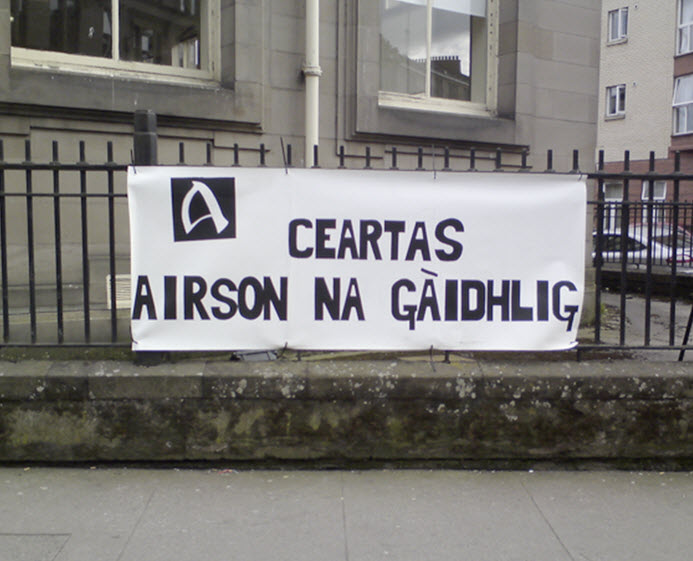
Some great news for the ongoing development and growth of the Scottish language. The government of Scotland has announced a major increase in the funding of Faclair na Gàidhlig, a project to establish an online Scottish dictionary similar to Ireland’s Foclóir.ie and Focal.ie.
From the BBC:
“The Scottish government has given £2m funding for an online Gaelic dictionary that could take 30 years to complete.
Work has already begun collecting source material for a digital archive containing 30 million words.
The project is a partnership of Skye’s Gaelic language centre Sabhal Mor Ostaig UHI and Aberdeen, Edinburgh, Glasgow and Strathclyde universities.
The aim of the project is to produce a historical dictionary of Gaelic that will be comparable in value and status to dictionaries already available for Scots and English.
Gaelic national body Bord na Gaidhlig has supported the work since 2004 and contributes £75,000 a year.
Sabhal Mor Ostaig UHI is managing the project called Faclair na Gaidhlig.
First Minister Alex Salmond has welcomed the new funding package.
He said: “We’re committed to working with a range of other public bodies to create a secure future for the Gaelic language.
“The dictionary initiative will play an important part in that work and I’m delighted that this extra funding has been identified to drive forward the project.”
The Comments on the BBC article and a related report in the Scotsman newspaper are interesting to read, not least for the examples of the same racism that Gaelic speakers in Ireland experience from their English-speaking peers. Indeed the bigotry of an anglophone supremacist minority in both nations expresses itself almost identically with the added twist that some in Scotland disparage the Scottish language for being allegedly “foreign” to their country. Unlike of course the English or Scots-English tongues…


Nice one, Sionnach, though inevitable backlash over there that’s ‘background music’ in this state (“one billion euro central bank monies on the irish language!”) – Can I stick my head up and ask really who benefits from a publicly funded online-only dictionary (many Irish speakers are in their 70s, 80s)? Fair enough 2 million pounds sterling for 3 year project but look what happened with Royal Irish Academy Irish dictionary: do we know (or allowed to know) how much that cost and for how long that went on for? I bought three pocket Irish dictionaries in 2006 printed and published not here but in Alban and for last decade or so Collins and OUP have published Irish dictionaries – why aren’t the varying Irish etymology projects in Irish publicly funded institutes, colleges, publications etc allowed to fracture the ambition of creating a regularly updated authorised Irish language dictionary (print and online) – the funding was there during the “boom” for the RIA’s laudable though costly biography volumes (published and printed outside state) – all things considered it smacks of academic largesse – why couldn’t the army of summer months’ (underemployed) state Irish teachers be seconded to work on an Irish dictionary? Is it because it’s considered part of the “expectation” to pay public servants a second time on top of getting paid for doing no state work during July and August? (God forbid! I’ve broken an unspoken rule!) :-#
LikeLike
Some good points there though in general I am a firm believer in the necessary confluence of technology and minority languages in the roles of service, education and expansion (revival).
That said one longs for Ireland and the Irish language to have an institution as prestigious and well-regarded as France’s “Académie Française”. The French Republic regards the latter as one of the defining institutions of the state – of the nation. Even though many French regard it as fusty and over-particular it is still held in high regard and deemed necessary by both the political and media establishments and the general public as a whole.
In Ireland we have a relative shambles with “Official Irish” stemming from the sometimes dubious decisions of the Rannóg an Aistriúcháin (the Translation Section) of the Oireachtas (sometimes even in opposition to the spellings/translations offered by the team involved in the creation of the Foclóir). Despite its good work the Rannóg an Aistriúcháin is no academy. I think that ties in with your point about creating a single official, fully comprehensive online Irish language dictionary (Irish-English and English-Irish) free to all users and regularly updated. The Old/Middle Irish dictionary, the terminology dictionary, etc. should all be one and it is utterly counter-productive to pursue the fractured nature of online Irish language resources.
Surely it is time for someone to step it and regulate all this?
Pet peeve, probably a bit much from a non-fluent Irish language lover/unsuccessful-learner like myself. Why has Irish been burdened with the inclusion of non-orthographic letters? Are we going down the Ó Caoimh > Ó Cúiv route? At least Scottish (Scottish Gaelic) has more integrity.
Spelling reforms are all well and good but look how it lopped off the tree of Irish from its roots. Read anything published before the 1940s, even in the Latin alphabet, and most Irish-speakers would struggle. As for stumblers like myself. Two or three centuries of Irish literature in Early Modern and Modern Irish rendered beyond the grasp of most casual readers if viewed in the original form. And who these days would pay to modernise Irish texts from the 1700s, 1800s and early 1900s? 😦
LikeLike
SG never underwent a full-blown spelling reform, more of a gradual tidying-up process. Also we keep the hiatus in words like ‘fiathach’ ‘raven’ whereas Irish runs the syllables together, so the ‘old spelling’ is more suitable. The Education Dept. brought in a reformed system some years back, but went a little too far for some on us. See :
http://www.google.co.uk/url?sa=t&rct=j&q=&esrc=s&source=web&cd=1&cad=rja&ved=0CC8QFjAA&url=http%3A%2F%2Fwww.sqa.org.uk%2Ffiles_ccc%2FSQA-Gaelic_Orthographic_Conventions-En-e.pdf&ei=S-r2Ub29NsiNO7fmgYAM&usg=AFQjCNGoxnH4eOZ091wKf-YCtZfKtHuGHg&sig2=WqRnVyWyI61OMwt18vJE6w&bvm=bv.49784469,d.ZWU
Hmm … couldn’t find the page I was looking for, but this turned up :
http://www.his.com/~rory/orthocrit.html
LikeLike
I have to say I always thought the Scots were handling the matter of “reform” in relation to their Gaelic language in a far more sensitive manner than here in Ireland and with a real sense of continuity of speech and tradition. Even neologisms seem to follow a logic based upon native orthography and thought not some awful bastardization or importation of non-standard characters.
These days Irish seems content to take in anything and simply give it a meaningless Gaelic gloss. So in road signs “ramps” become “rampaí”. There are worse examples 😦
LikeLike
Well that’s not quite the same issue as spelling, still we all have our pet hates. At least you don’t have to suffer “bàidhsagal” (what happened to ‘caol ri caol’?), and don’t complain to your “tidsear”!
http://www.teagasg.com/gd/
In Wales, strangely, the education establishment seem to be amongst the worst offenders when it comes to using thinly disguised English jargon — you’d expect them of all people to know better. Of course it’s perfectly natural for languages to borrow words, but with a minority language if it’s overdone it can make it a laughing stock. I stumbled on a blog once by one of those English monoglot types who clearly didn’t really believe other languages were real. This view was confirmed by a trip to Wales where he saw signs saying “Dim Parcio”, “Dim Beicio”, “Dim Smocio” etc. and concluded that Welsh was nothing more than a kind of Pig Latin. He was dead wrong, but you can sort of see his point.
LikeLike
Ah yes, I rather think I prefer rothar and múinteoir in those cases (even with the Latin suffix of the latter word) 😉
I once had fun with a vicious real world troll at a house party who launched a tirade in my direction when he heard me me speaking in (stumbling) Irish to someone I knew and who was kind enough to indulge my aural assaults on her ears. His triumphant points proving the false nature of Irish turned on the “stealing of English words” for modern things in Irish: teilifís for television, etc.
When I asked him what the English was for “pizza” he stood open-mouthed before declaring pizza. Despite the fact that everyone around him was laughing he simply didn’t get it. In his world there was only English and all words in English were simply English with no further origin.
I’m a language traditionalist I suppose rather than purist. An eye for tradition should shape innovation but innovation is necessary.
LikeLike
Tocasaid: The new Scottish dictionary – some suggestions… 😀
LikeLike
Replying to our host below, it’s said that English doesn’t just borrow from other languages, it entices them up dark alleys and ruthlessly mugs them for everything it can take 😉
‘Rothar’ is indeed an alterative in SG, but we don’t have ‘múinteoir’ probably because with no stress on the second syllable it would sound the same as ‘muintir’ ‘folk’. The usual words for ‘teacher(s)’ are ‘fear/bean/neachd/luchd teagaisg’ and of course the more old-fashioned ‘maighstir sgoile’. The link I gave was just the first thing Google turned up to give an example of ‘tidsear’, but it’s well worth a look. Clearly GME is on a roll now in Scotland and they’re pulling out all the stops to recruit and train more Gaelic medium teachers and support workers. Very encouraging, the vids are really up-beat.
LikeLike
Better late than never. Just to point out that a lot of work, such as digitialising Dwelly (our Dineen) was only done in the last ten years or so and afaik without any up-front funding. For years and years (almost 100) publishers made a packet selling barely readable reduced photolitho copies, i.e. they couldn’t even be bothered to re-set the type. Apparently a re-set paper version is now being published from the digital files. The other major on-line source is the Stòr-data at Sabhal Mór. Now while this interesting institution seems to have become integrated into UHI and the academia in general, it might be worth pointing out that it began as a private initiative by a visionary (who as it happened was rather rich). The moral I suppose is don’t expect the government to help you unless you’re already on a roll. In which case they’ll happily jump on the bandwaggon and try to take the credit. Good news nevertheless.
LikeLike
True. Very true 🙂
LikeLike
Och, mo chreach! The BBC can’t afford graves and accutes (some of us still use both, but they apparently use neither). Would they try this game on with French or any other ‘real’ language?
LikeLike
Back again after reading many of the comments on the BBC site. I think I’ve finally figured out their game. On the whole the Beeb are pretty pro-Union and anti-Scots, and when the do have a piece on Scots politics comments are not allowed. Yet here is apparently a positive Scots story with comments. Hmm … can you see how they’ve cleverly spun it (playing on the general public’s ignorance of Gàidhlig and linguistics in general)? Essentially they’ve managed, as much by ommission as inclusion, to give the impression that a great deal of money (really not that much for a nation of 6M) is to be spent on apparently the first ever Gaelic dictionary (that’s the impression given) and it will take all of 30 years (by which time the language will no doubt have died out?) No mention of existing dictionaries, paper and online, going back at least 150 years, nothing to put it all into context. Nothing to say that Gaelic in Scotland has been gradually increasing it’s visibility over several decades … no, it’s all a cunning plot by Big Eck and SNP. Cleaver little buggers the Beeb, just prime the pumps with some subtle disinformation, open the floodgates to uninformed comment, and bingo! the BritNat bigots will do you’re work for you, and it’s all deniable.
LikeLike
Those Comments seemed to have got you fairly riled up. Anglophone trolls do tend to have that effect!
LikeLike
Not the trolls themselves, although the widespread ignorance about how languages develop and functions is indeed shocking. No, my annoyance is in how the BBC and their masters are clearly using them as a kind of rent-a-mob. It doesn’t reflect the balance of opinion in Scotland. Polls seem to show a small majority of Scots support the extension of Gaelic, I think something like 25% strongly support, and of the remainder by far the most are indifferent. Those actively opposed are IIRC 10% or less. Likewise the Gaelic Language Act which gave official status to G. in Scotland (don’t laugh) had all party support and passed unopposed in the Scots Parliament a few years back.
LikeLike
RESEARCH REVEALS POPULAR SUPPORT FOR SCOTTISH LANGUAGE
LikeLike
It appears that any Gaelic comments are automatically removed by the BBC mods. And the Gaelic version of the article does not allow comments … hmm …
http://www.bbc.co.uk/naidheachdan/23464720
LikeLike
Was looking at bbc article earlier, Marconatrix, and seemed like comments closed after a period – I’d more likely blame lazy journalist for not putting news story in context – either way “Scottish identity and native language”? Reminds me working as a subcontracted data entry monkey 11 years ago and talking to Scottish worker (about 21 yr old) and got aggressive when I asked him the same: he talked about the comings for some reason and that Scotland was a multicultural country – in hindsight I’ve no answers – then again only this week or last 4fm presenter took offence at people saying he was ‘less Irish’ for not being able to speak it – perhaps there is a collective albeit subconscious shame among Scots that their “culture” – much like the Irish administration’s ‘gathering’ – is completely divorced from the native language! Sloppy – deliberate in that sense for definite!
LikeLike
Vikings! That’s what fella 11 yrs ago was talking about (damn smartphone autocorrect!)
LikeLike
Oh yes, you frequently hear that old chestnut about the Vikings from anti-Gaelic anglophone Scots. I challenged one a few years ago on the basis that if he really believed Old Norse was as native to Scotland as the Scottish language would he favour Icelandic or Norwegian being given equal status with English. I won’t repeat his answer. Its like the bluff argument by Anglobigots here in relation to Polish. “More people speak Polish than Irish!”. So you favour Polish-language schools and official publications? Of course not! It’s just mindless noise put up to deflect from the real arguments – and their real bigotry.
Funny how the “multiculturalists” in the Celtic nations always mean English multiculturalism… 😉
LikeLike
outstanding! i wish i had that comeback -:)
LikeLike
Most of the Norse in Scotland became gaelicised, but left their mark on the landscape and the language. This is part of the reason why Scots G. is different from Irish, even the Northern Irish dialects. In the Northern Isles Norn was replaced by a local form of Scots-English with it’s own special features, not all due to Norn though. Attempts to standardise Scots-English spelling etc. work fairly well over the mainland, but Shetlandic in particular just won’t fit. If you look around the web you can find attempts to reconstruct Norn, but unfortunately, unlike Cornish say, there is too little material to go on. You’d probably be better off learning Faeroese which is the nearest surviving language.
LikeLike