
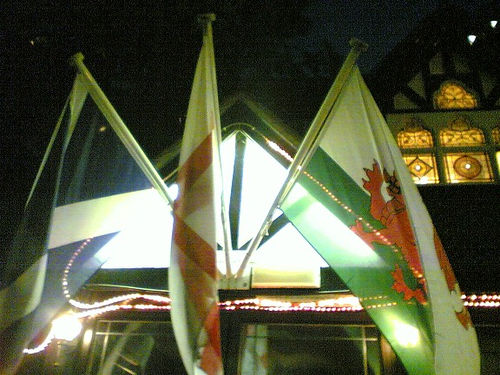
In the 2011 census on the island of Britain large numbers of people living in Scotland, Wales and England rejected the nationality of “British”, a majority in all three countries preferring to describe themselves instead as solely Scottish (62.4%), Welsh (57.5%) or English (60.4%). Which makes the BBC News article claim that Britishness is “…an identity quite at home in the 21st Century” more than a little bizarre. Indeed the whole post is rather odd with some amazing fact-spinning not to mention this nugget of suggestive bias:
“In Wales, though, children and young people are less likely to describe themselves as British than their parents – about 16% compared to 18%. One possible explanation for this may be the introduction of compulsory Welsh language teaching in schools.”
Desperate man clutching at straws? The English language is also “compulsory” in schools in Wales and for 90% of the school day. Yet Welsh schools are not turning out legions of flag-waving EDL supporters. And 98% of the Scottish education system is through the medium of English with hardly any input from the Scottish language outside of a few Scottish Gaelic schools (for now). Yet the vast majority of young Scots also reject any sense of being British.
If the argument is that the provision of Welsh language education for Welsh students is decreasing the number of those identifying themselves as “British” in Wales, is that not merely underlining the purpose of English language education in Britain as a force of cultural colonialism?


Until the last decade or two, Scottish national consciousness has had little really to do with Gaelic, at least not since the days of the clearances etc. It was always there in the background of course, praised, despised and patronised by turns. However Scots nationalism is mainly political in nature, looking back to the time when Scotland was a modern nation state. Remember we kept our legal system, church, health and education systems etc., they were never merged with England’s.
Wales otoh is a different kettle of fish. The nearest they ever came to statehood was probably the few years of Glyndŵr’s rebellion, when they had a national parliament at Machynlleth. Wales was conquered piecemeal by the Norman marcher lords with the English king finishing the job. After which the whole lot was parceled up and made legally part of England. They had no separate political identity, only a strong cultural identity focused on the language. All the separate political institutions and separate legistation for Wales are quite recent. Also it’s all a ‘gift’ from England. That is it can at least be argued that the union with Scotland is subject to an international treaty with gives them the right to separate. The Welsh have no such right, everything they’ve been given could be taken away should Westminster so choose.
While from your vantage point ‘British’ nationalism is seen as anti-Irish, it is also from a British pov a possible inculsive civil identity. ‘British’ is the identity choosen by immigrant groups, we’re used to hearing about ‘Black British’, ‘British Asians’ etc., no doubt with echos of the Empire. But if a non-white person described themselves as ‘English’ it would a best sound a bit odd, and I’m afraid in many places people would probably laugh in their face. Thus English nationalism has the potential to turn much nastier than British nationalism has ever been, at least in its home island. This is the problem, ‘English’ has never really been cultivated as an inclusive civic identity for people to join, ‘British’ has generally filled that rôle, ‘English’ is seen as just one more strand in a multiculural mix.
How all this will pan out,, should Scotland regain its independence, and in the process dissolve Great Britain, so that most of what’s left then identifies as ‘English’ is difficult to foresee …
LikeLike
Some very interesting points, Marconatrix, and I would agree with most of them. There is a strength to Welsh national identity that is bound up with language rather than politics or constitutional legality, and in a way that is very different to Scottish national identity. The idea of the “Act of Union” is much more important north of the border than south, and is seen by many Scots as the union of two separate nations rather than the annexation and extinguishing of one by the other (though legally that is the British government’s position, something the Tories, Lib-Dems and Labour have all signed up to – Ireland interestingly is always described as a “colony”). Scottish identity is a (arguably stronger) blend of political, legal, constitutional and cultural matters (the latter now 95% Anglophone / 5% Gaelophone).
I can see the argument for British identity as an open and civic one though I might dispute it.
I have several friends who would describe themselves as “English nationalists”. However they would be Left-voters, socialist or social-democratic, supportive of an independent England and the end of the UK, very friendly in attitudes towards the Celtic nations and the continental ones too, ashamed of the era of empire, and more Billy Bragg than EDL. That said they would be cultural nationalists in the sense of a JRR Tolkien.
What England needs is an English SNP if you get my meaning. To yield the field of national identity in England to the likes of the EDL, NF and UKIP is a mistake. Where are the left-wing English nationalists? Is it that Englishness can only exist as a form of Britishness and of the Right? Is it, as I have argued, the case that Britishness is simply Greater Englishness and that a separate English identity is actually a threat to the hegemony of Greater England on the island of Britain?
LikeLike
I agree that an ‘English SNP’ would be wonderful, it’s just difficult to see how it might arise. All the London political parties now look identical, so short of a major split in Labour all they can turn to is UKIP, which does actually articulate the feelings and frustrations of many ‘ordinary English people’ fed up with the Westminster cliques, and they even manage a bit of humour at times too. I think many of their ideas are misguided, even dangerous, and of course they have pledged to roll back devolution in Wales. An independent Scotland would by then be a separate nation, no help to the Welsh, it could not, and would hardly wish to meddle in England’s internal affairs. “Interesting times” ahead maybe, as in the old Chinese curse.
Btw there was no better demonstration of the gulf in political outlook between England and Scotland than the reception Farage got in Edinburgh a while back, along with his total incomprehension at the backlash he provoked.
LikeLike