
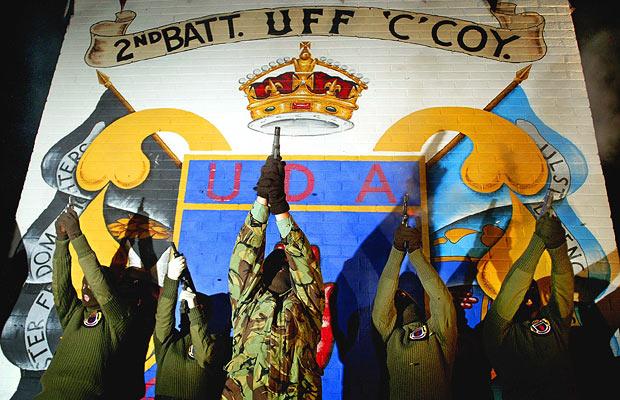
As if the precarious position of Irish-speaking citizens and communities in Ireland was not difficult enough living under the authority of a state hostile or indifferent to their needs, in the north-east of the country they must also face the threat of violence too. From the Belfast Telegraph:
“A community centre has suffered a wave of attacks from sectarian thugs motivated by the mistaken belief it was hosting Irish language classes.
The Dunanney Centre in the loyalist Rathcoole estate has denied the language classes are held there after it was daubed in anti-Catholic graffiti in the latest of a series of attacks.
The centre is run by the Rathcoole Churches Community Group and provides various community facilities, including employment training.
Mrs Hutchinson said centre officials met with politicians and representatives linked to the UDA and UVF.
Both groups condemned the attacks and said they were not sanctioned by them.”
Not sanctioned by them because the centre is not actually providing Irish language classes of course.
 AN SIONNACH FIONN
So fostering bilingualism in Ireland will not only fulfil the aspirations of those who still feel a strong connection with an Gaeilge but it will also hugely benefit our 21st century economy.
————————–
Irish is a foreign language for 90%+ of the Irish and must be learned as such.
So if you’re going to learn a foreign language – much easier, cheaper and efficient is to learn a language, that’s required for a job that you desire, right away instead of learning Irish first.
And also languages like German, Dutch or Swedish are actually a lot closer to English than Irish.
LikeLike
“…if you’re going to learn a foreign language – much easier, cheaper and efficient is to learn a language, that’s required for a job that you desire, right away”
And if the Soviet Union / Russia had succeeded in the Russification of a majority of the Latvian people? Would you still hold that position? 😉
LikeLike
I were a native Russian speaker in a country where Latvian is spoken only by a very small minority then I probably would not bother to learn it.
However if they had succeeded then Russia/USSR probably would have been a very different country.
Because why would an educated and literate nation take language and culture of uneducated and illiterate peasants?
And that’s not some kind of Russophobic insult.
As you can see in this map – 70-80% of Russians outside of St. Petersburg were illiterate by the end of 19th century.
LikeLike
The point you’re missing is that the Irish already have a world language, English, to near-native standard 😉 So they may as well learn the local language so they’ve got one of each. You already have your ‘private’ local language, so your need was to learn a world language, in Soviet time that would have been Russian, now its English. Your priorities were the exact opposite to those of the Irish, Welsh etc. Of course most anglophones remain stubbornly monolingual — Their loss.
LikeLike
There can be many reasons to learn Irish – easier acquisition of foreign languages is not one of them.
Celtic language skills will not help you to earn more money unfortunately.
LikeLike
Speakers of Irish are half as likely to be unemployed!
LikeLike
There is a report about Irish-speakers enjoying greater levels of socio-economic mobility that I featured some time ago.
LikeLike
Interesting map btw. Could the literate areas be the ones that were protestant, since the protestants put a lot of emphasis on everyone being able to read the Bible for themselves, while the Catholic Church was opposed to this, e.g. the way they persecuted anyone who translated scripture into the local language. Do you tell “Irish jokes” about Lithuanians, the way the Dutch do about Belgians?
LikeLike
Yes – areas with 80+% literacy are lutheran.
Latgale (the region I’m from) and Lithuania with ~50% literacy are catholic.
And in both of those areas usage of Latin script was forbidden for ~40 years – that might explain lower literacy rates.
Baltics was the most educated and prosperous region in the Russian Empire.
——————-
Do you tell “Irish jokes” about Lithuanians
——————-
No – we tell “Irish jokes” about Russians.
LikeLike
Are you saying Latgale used Cyrillic script? When would that have been, your map is from 1897. Also some of the Eastern regions would, I imagine have been Russian Orthodox christians. I’ve no idea where they stood on literacy, although the map would suggest they were even worse than the Catholics.
Ah, spotted the slender-r in ‘jūŗas’ which I suppose is consistent with the date. At least you had a neat way to write it. In Irish you’d have to insert two dummy vowels, ‘iúireas’ to have the same effect, one of the reasons why written Irish seems more complex than it really is.
LikeLike
No they did not use Cyrillic script. They printed books illegally or smuggled them from abroad.
The ban was in place between between 1865 and 1904.
Education in Latvian/Latgalian also was forbidden at that time, because Russian Empire tried to russify the area.
Yes – Russians were either Russian Orthodox christians or Old Believers.
And as you can see in that map – only ~20% of them were literate.
I went through a crash course of Irish ortography.
And I’m wondering why Irish don’t use diacritics on consonants as well.
And also why does it have strange rules like “In digraphs and trigraphs containing a vowel with an acute accent, only the vowel with the accent mark is normally pronounced”?
We got rid of weird rules like that more than 100 years ago and now Latvian spelling is phonetic without any stupid exceptions, silent letters or anything like that.
Maybe Irish spelling should be reformed to be more phonetic as well.
LikeLike
Gaelic spelling was historically based, which means there was order in the madness so long as you knew how to apply several centuries’ worth of sound changes. This is essentially the system still used in Scotland, it’s more logical than English spelling, which isn’t saying much. Irish changed from a system like this to a sort of part phonetic part historical system, but to be fair to them, on the one hand the language had evolved further than in Scotland, justifying some of the revisions, e.g. dropping silent consonants — but on the other hand they needed to cater for diverse dialects, hence the retention of older forms that had developed differently in different places. (And if you think it’s a mess, just take a look at Manx spelling, which is sort of semi-random English-based and looks silly to other Gaels).
Diacritics were a bit of a problem in English-speaking parts of the world, at least until unicode came along. The Welsh were complaining for years that they couldn’t write ŵ and ŷ. Irish was less of a problem since accutes were used in other major European languages. However English speakers don’t see diacritics as an essential part of a word, just a kind of optional extra, so tend to just strip them off.
As regards to the dummy vowels (not pronounced or at best a glide), Polish has a much more logical system, it simply adds “i” after a soft consonant, and if the vowel is /i/ it’s written “y” after a hard consonant. At least that’s what I remember from years ago. That only leaves final consonants that don’t match the vowel they follow, where I think diacritics must be used. Irish works in the same sort of way but you need to learn all the (written) vowel combinations to know which are the real vowels and which dummy ones. Also they add dummy vowels where necessary on both sides of a consonant within a word which is really overkill, Old Irish managed without this.
Sorry for the OT rant Seumas / Séamas / Šēmas. At least these days its easy to hear Irish etc. spoken so you don’t have to puzzle out the pronunciation. Same language subtitles are especially useful. This for instance goes into Irish after the introduction and has dual subs (from 2:34) …
LikeLike
but on the other hand they needed to cater for diverse dialects
—————–
If a word is pronounced differently – you write it differently – problem solved.
LikeLike
If a word is pronounced differently – you write it differently – problem solved.
——–
They tried that for a while, but it meant printing three versions of all their school books etc.
LikeLike
Hi Marconatrix, for some reasons your links are being striped out from the Comments (I presume you’re leaving some). I have no idea why. Will check what is going on.
On rants, the more the better when they are so well made!
LikeLike
Irish spelling was reformed in the 1940-50s (along with the alphabet) and it was disastrous in terms of cutting off native speakers from the written word and new speakers from several centuries of the written word. Many books in the Irish language written in the 18th, 19th and early 20th centuries are now almost illegible to modern Irish-speakers due to state-imposed changes in the print-types and spelling. The road to hell is paved with good intentions…
LikeLike
Many books in the Irish language written in the 18th, 19th and early 20th centuries are now almost illegible to modern Irish-speakers
—————–
Is that a big deal nowadays?
They all can be scanned in a computer and then converted to the new orthography.
LikeLike
True but where is the will (or money) to do so? And the damage has already been done. In the 1960s-80s Irish-speakers of a certain generation found themselves dealing with a language increasingly unfamiliar to them, both in print and orthography. Inter-generational use of the language in traditional Irish-speaking communities was certainly harmed by the “reforms”. A language is much more than its spoken form, it is the written form too, the whole “cultural package”. My mother was a fluent, bilingual speaker of Irish as a child and teenager. Now she finds contemporary Irish difficult (impossible?) to read and difficult to follow. She stills makes use of the Tironian sign “et” when writing in English, which comes from Irish type. Top-down “reforms” can have unexpected effects.
LikeLike
Well – some Latvians probably did not like the Latvian spelling reform as well – but so what?
I think that the current orthography a lot better than the previous one.
—————
True but where is the will (or money) to do so
—————
Are you saying that all the old books haven’t been digitised yet?
Unbelievable.
LikeLike
Google Books has done a good job of digitising some Irish language texts dating from the 1700s to early 1900s however that is not the same as OCR transporting “Early Modern Irish” texts to “Reformed Irish” fonts and orthography in digital formats. That requires coding, software, researchers, sanity checks, etc. and then packaging as ebooks. It should be done (preferably with the previous, Gaelic font, unreformed texts alongside, also in digital form. All have been standardised under ISO).
LikeLike
Rants : grma but I should probably be writing my own blog instead of hijacking yours 🙂
LikeLike
I know Polish people tell “Lithuanian” jokes and Czechs “Polish” jokes.
The rivalry between Danish and the Norwegian dialects makes for many jokes along the supremacist or pejorative line.
LikeLike
Compare and contrast with the bizarre case of Ullans, Ulster Scots, Scotch or whatever it is called this week. It took me years to learn French but Hey! I can add another language to my CV. Just (Jist?) speak with a Ballymena accent!
LikeLike
Speaking Ulster-Scots in not speaking with a Ballymena accent, any more than speaking Irish is speaking with a Crossmaglen accent : read Brian MacLochlainn’s excellent article in a past issue of The Glens of Antrim Historical Society’s magazine (available online.) There is an awful lot of ignorance re Irish and Ulster-Scots. Perhaps if the people attacking this centre in Rathcoole were aware of the Irish origin of their Estate’s name, it might help to change attitudes, though I would imagine that only a tiny minority are involved in such attacks.
LikeLike
That magazine is not available online as far as I know.
LikeLike
Look up the Glens of Antrim Historical Society’s website, all their recent back issues should be available online, I have downloaded them in the past. The French academic journal “Etudes Irlandaises” recently produced an issue on Ulster-Scots, under the direction of Prof Wesley Hutchinson ( a native of Mid-Antrim) of the Sorbonne Nouvelle, Paris. I attended the same school as the Prof and recall spending a few days of my Uni holidays in the 70s with him in the artificial Rathcarn Gaeltacht in Meath, where he was perfecting his Irish.
Of particular interest to me was an article by Laura Spence of the B.B.C., in which she made it clear that in its supposedly Ulster-Scots output the B.B.C. uses a “light” version of the dialect, in order to attract a wider audience, in other words what they are broadcasting is not Ulster-Scots at all, but Standard English, with a few well-known dialect words thrown in to give it an authentic feel. Little wonder that the general audience think that it is merely consists of employing a Ballymena accent! As a native speaker of this barbarous patois, I never listen/watch these programmes.
Paradoxically the best example of Ulster -Scots was produced by an independent company and broadcast by R.T.E. in the 1990s, a film about the lives of two brothers living in Glenarm Glen, called “Us Boys,” sub-titles were employed and needed, as the proper dialect was used.
LikeLike
All, here is a link to the Glens Of Antrim Historical Society.
From Études irlandaises, “Ulster-Scots in Northern Ireland today: Language, Culture, Community“.
LikeLike
Learning German, French, Spanish is an excellent idea. Especially if you intend to go and live in Germany, France, Haiti, Spain, Latin America. Replacing Irish with German, French, Spanish in schools is not such a great idea. First off we are not all going to be international business entrepreneurs or going to live in Germany, France, Spain. Most of us will remain in Ireland and most of us would like to know a little about the culture of the country we live in. Besides do most of us not speak the international business language already? It is time to focus on our own language and give ourselves another reason to stay at home.
LikeLike
Most of us will remain in Ireland
—————
Are you saying that most of you will never set a foot outside of this island?
LikeLike
Excellent point on English, Colmán. It is already one of the de facto languages of international commerce. So why learn languages that are clearly not when they bear no relationship to our nation/identity/history/heritage, etc? It is a spoof argument put up by Anglophone supremacist pretending to be liberal thinkers. Total red herring. They have no more time for Chinese than they do for Irish.
LikeLike
“So if you’re going to learn a foreign language – much easier, cheaper and efficient is to learn a language, that’s required for a job that you desire, right away instead of learning Irish first.”
That comment makes no sense at all. It’s not logical and doesn’t fit with conditions in Ireland, either.
The infrastructure and resources for learning Irish are available all over Ireland. The other languages you mention are far less available to people in Ireland. This isn’t a bad thing – the more languages you learn, the easier it becomes to learn more. Bilingualism doesn’t prevent further language acquisition. In fact, it’s easier to argue the opposite.
Additionally, most of the people I know who learned another language didn’t do it for their career, including myself.
LikeLike
the more languages you learn, the easier it becomes to learn more
—————–
It becomes easier to learn languages that are related to those languages that you already speak.
Unfortunately Irish is related to languages that are even less spoken than Irish itself.
English is not only the lingua franca of the world.
Knowledge of it also helps to learn other Germanic languages.
LikeLike
Actually there’s so much French/Latin vocabulary in English that it probably more help with learning Romance languages. If you have basic French and need to read a technical article, you can generally recognise most of the specialist terms because they’ll be like English most of the time. Doesn’t work with German though, there the everyday words might be familiar but anything specialised is a nightmare.
Irish does at least (by chance despite some wild theories) have some syntax that resembles Arabic (VSO sentence structure, no verb ‘to have’, prepositions compounded with pronouns). The serious point being that it will loosen up the learner’s ideas of how languages work, more so than a run-of-the-mill mainstream Western European language. So it might help anyone who later needed to learn a more exotic language. After all, if you’re going to learn another language for practical reasons the ones you’ll need are those from places where everyone *doesn’t* learn English to a high standard. Which rules out most of the Germanic and Romance languages.
LikeLike
If you’re going to live anywhere in the EU other than the UK and Ireland – you should learn the local language – otherwise you’ll be frowned upon.
LikeLike
Tas ir skaidrs, paldies 😉
LikeLike
“It becomes easier to learn languages that are related to those languages that you already speak. Unfortunately Irish is related to languages that are even less spoken than Irish itself.
English is not only the lingua franca of the world.
Knowledge of it also helps to learn other Germanic languages.”
Well, this is a problem for your argument. You’re saying people should learn languages for the economic benefit, and it’s best to learn a language similar to their own. So for English speakers, you advise that they learn another Germanic language. But none of the other Germanic languages are useful for English speakers, because the speakers of those languages largely know English, especially the Dutch and Germans. You’re painting yourself into a corner here, because following the logic of your argument, there’s no point for a native English speaker to learn another language out of economic necessity. So they might as well learn a language for enjoyment or cultural reasons.
LikeLike
Far more people learn languages out of economic necessity than for enjoyment and cultural reasons.
Linguistics is not everyone’s hobby.
—————-
because the speakers of those languages largely know English, especially the Dutch and Germans
—————-
Yes, but if you want to emigrate and work in the EU – you need to learn at least one of the EU languages – and most popular are Germanic, Romance and Slavic.
(And I think that everyone should emigrate and work in a foreign country at least once in his life and emigration don’t have to be permanent)
The Irish generally don’t speak more than one language and that’s why they can’t use all the benefits the EU offers them in this area.
They have to apply for a visa and fly to the other side of the world instead.
France and Germany are closer than Canada and New Zealand 😉
LikeLike
The Irish fly to the other side of the world as there’s already an established diaspora community there, GAA clubs, pubs, Irish owned businesses, a network. So it makes good sense in almost every way. Now, funny enough, it’s yourself making the argument that they should learn a new language and go somewhere else where there will be less of an economic incentive. 😀
“Far more people learn languages out of economic necessity than for enjoyment and cultural reasons.
Linguistics is not everyone’s hobby.”
There have been some successful large scale language revivals. The examples most useful to the Irish would include the Basques and Catalans. The Czechs are also a very instructive example. The language was receding from the cities and largely out of print. During Astro-Hungarian dominance they still managed to return the language to national prominence. You can’t argue those revivals were successful due to economic necessity as it isn’t so.
LikeLike
Fair point, Jānis. However, and purely my own experiences here, Irish-speakers from Ireland tend to emigrate within the EU, English-speakers from Ireland normally emigrate out of the EU (excluding emigration to Britain, of course).
LikeLike
Learning Irish is certainly not going to be of a benefit in an economic sense. No, it will not help in understanding any other language except those related and even more obscure. Learning Irish is essential to understanding oneself if one is Irish (or any other gaelic variant or descent). It will force you think in the manner your ancestors did. It will enlighten you in many ways and fill in many of the gaps – if you let it and do not insist on looking at it as a burden or in terms of a political view. Language is the continued identity of a people and their culture. It is the only thing that carries forward. Once a language is gone, culture and people are gone, assimilated into another culture and people. They may still have ancestry, but no longer the identity. In the United States and Canada you can really see that with so many of those who have immigrated. They are now American people and of the American culture, no matter how Irish, German, Persian, Arabic Chinese, Japanese, Russian, Latvian, etc… they may think they are. Similar to other countries that have suffered long-term occupation by another, the fight for the Irish language is also a fight for the Irish identity – that is why any notable champion for Ireland and Irish freedom (or any other long-term occupied country) is also a champion for its language. Its preservation is also the preservation of the Irish culture. You will never truly “understand” a gaelic poem unless you read it in gaelic. Most of our history is in poem and song (for most of it there was no writing). If everyone only spoke English and read a translation, none of these treasures would ever be truly understood again. It is like loosing your soul – hence the slogan: Tír gan teanga, tír gan anam.
LikeLike
And what about the Breton language , Ar Brezhoneg ? Do you know that it’s still one of the most spoken celtic languages (after Kembraeg), belonging to the breton branch.
Are you aware, too, that the french governments since more than a century are hypocritaly doing their best for sqqeezing to death that language ?
Look at the TV net, for example: the Welsh have Spedwarek, the Scotts have a Gaelic channel, ,the Irish have a channel dedicated to Gaelic . At the opposite in Brittany we have….4 minutes in Breton language weekly !
And the french are every day and everywhere speaking about Human Rights that they, of course, invented ! Meanwhile they are the only ones (with the Greek) who have not signed the European Charta for Minorities and small languages.
Many breton speakers here, Brezhonegerien, would be very pleased to join a common interceltic force to defend and improve together a vigorous action at European and International Level for defende and promotion of all the celtic languages.
gant hor gwelañ gourc’hemennoù.
Ar Gwenedour
LikeLike
Good point, I examined that briefly here.
LikeLike
In my experience most of those who recommend replacing Irish in schools with Spanish, French, Chinese do not speak any other language except English. Learn Irish first and the rest of the languages will come easily. Irish is gramatically similar to most European languages, it is also phonetically similar. The main differences are in terms of vocabulary but this is easily surpassed through our knowledge of English which is a Germanic language that has borrowed alot of its vocabulary from Latin and French. A firm grounding in Irish will help in learning new languages as Irish uses alot of the same gramatical tools as other European languages which the English language has disgarded for example masculine and feminine nouns.
LikeLike