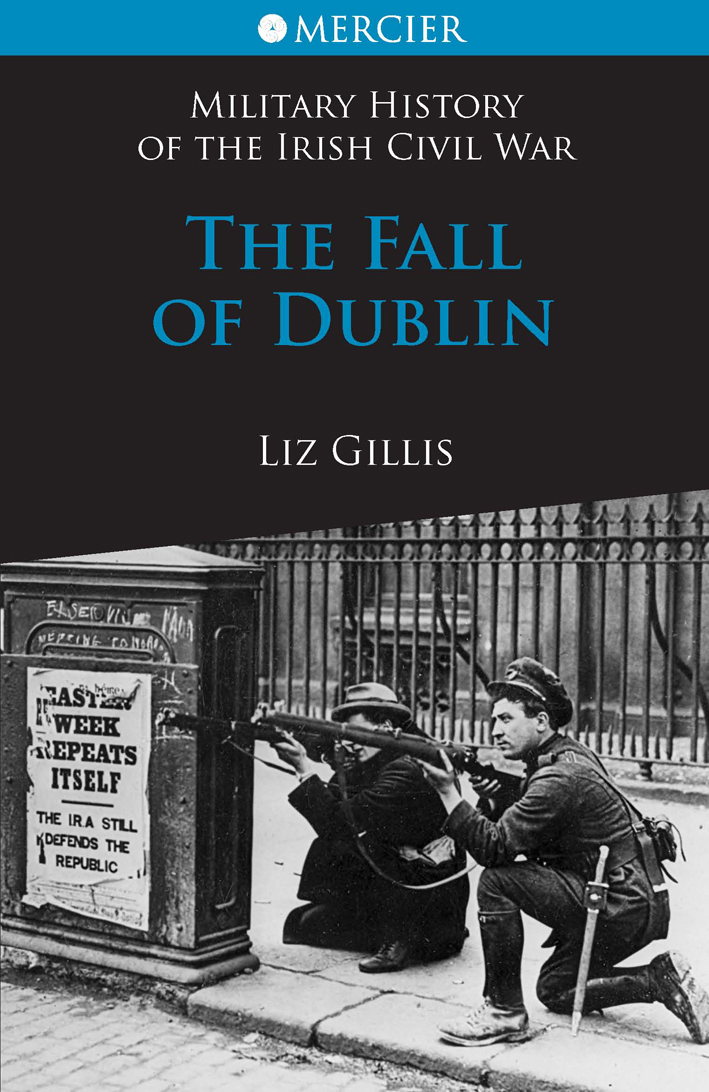
Liz Gillis ‘The Fall of Dublin’
Ireland’s Civil War of 1922-1923 must surely mark one of the lowest points in modern Irish history, an internecine conflict the meaning of which continues to divide public opinion. In my childhood it was barely touched upon, inside or outside of school, though the little that was known was enough to create a division (amongst teenagers that cared) between those who identified with the ‘Republican’ side and those who looked to the ‘Free Staters’. Like the civil war itself it was an almost instinctual feeling that left one for or against ‘the Treaty’, regardless of background, class or family (though, occasionally, not).
Despite previous general accounts of the conflict, noticeably Michael Hopkinson’s ‘Green Against Green: The Irish Civil War’, few works have focused on the core military aspects of the conflict, until the Cork-based Mercier Press launched its series ‘Military History of the Irish Civil War’. We have had ‘The Battle For Limerick City’ by Pádraig Óg Ó Ruairc and ‘The Summer Campaign In Kerry’ by Tom Doyle, both of which highlighted the struggles in the south-west of Ireland. However we now have Liz Gillis‘ ‘The Fall of Dublin’ which examines the first, and perhaps deciding, battle of the conflict: the contest for Dublin City.
By the summer of 1921 the Irish Republican Army (IRA) and the British Forces in Ireland had come to a pivotal point in a contest that had lasted for only two-and-a-half years yet had seen Britain’s centuries old mastery of the island as a semi-colonial possession within the United Kingdom of Great Britain and Ireland challenged as never before. The paramilitary police force of the Royal Irish Constabulary (RIC), the visible face of British rule for decades, had been effectively neutralised through a short war of attrition and communal ostracisation, despite being bolstered by two organised bodies of mercenary recruits composed of veterans from Britain’s demobbed Great War armies. The first of these was the ‘officer class’ Auxiliary Division of the Royal Irish Constabulary or ‘Auxies’ while the second was the ‘common soldiers’ of the Royal Irish Constabulary Reserve Force, more infamously known as the ‘Black and Tans’ or ‘Tans’.
The regular British Army, from what was originally a secondary position at the start of the conflict, had become the main counter-insurgency force of the British state in Ireland by the summer of 1921. Yet a lack of resources or clear strategies left it unsure of the way forward. Most cities and major towns, including Dublin, Cork, Derry and Belfast, were under curfew, and Martial Law had been imposed in the counties of Cork, Kerry, Limerick, Tipperary, Clare and Waterford, with several other midland and western counties scheduled to be added to the list. As the British civil administration crumbled away in many rural areas its authority was replaced by that of the underground Government of the Irish Republic empowered by Dáil Éireann, the twice-elected revolutionary parliament.
Meanwhile Irish Republican Army was successfully generating a wide pool of Volunteers (military recruits) in both ‘active’ and what had been previously ‘settled’ areas (though it was struggling to find enough arms and munitions to arm those potential new members). Where military clashes were not occurring due to a lack of weapons or equipment, local IRA units were actively engaged in recruiting, training, intelligence gathering, logistical support to neighbouring ‘restless’ areas, boycotts, political campaigning, and generally confronting or undermining British rule by other means.
By the third year of the War of Independence the British authorities in Dublin and London could only exercise unchallenged rule in those parts of the country where significant local British ethno-nationalist communities lived (that is populations descended in the main from British colonial settlers). This was most apparent in the northern province of Ulster, where the British Unionist minority on the island formed a regional majority embracing a form of violent separatism from the rest of the island that eventually led Britain to impose a partition, or border, across the north-east of the island creating two semi-autonomous regions within the United Kingdom of Great Britain and Ireland: Southern Ireland and Northern Ireland.
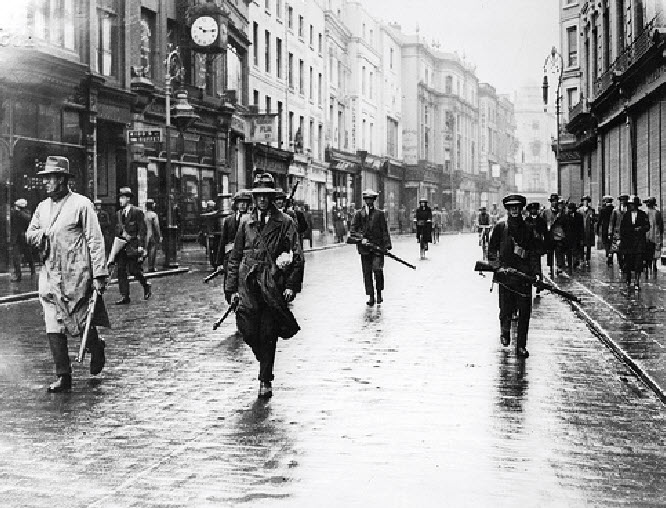
As the guerilla war in Ireland approached a crucial phase of ultimate victory or loss for one side or the other in the summer season of 1921 several months of secret negotiations between Irish and British representatives yielded a formal ceasefire or Truce on July 11th of that year. In this part of the conflict, at least, the British can be said to have blinked first. In fact many on both sides expected the war to resume and used the period of the Truce as a time of regrouping. The IRA was put through intensive training, large scale exercises were staged, local and regional intelligence was gathered and assessed, while preparations were made for a renewed conflict (it should be noted that in the North of Ireland the fighting didn’t end with the ceasefire, and in fact the northern campaign of the War of Independence can be said to have lasted until early 1923, with major engagements from April to June of 1922). The British too prepared themselves for imminent and ‘terrible war’, a threat made in London during the ongoing peace talks between the representatives of the two governments that in part influenced the decision of the Irish negotiators to sign a Treaty with the British on the 6th of December 1921.
Narrowly ratified by Dáil Éireann back in Dublin, the Treaty split both the political and military wings of the Republican movement, as a small majority of Sinn Féin politicians supported it while the vast majority of Irish Republican Army soldiers rejected it. Rather than the independent and sovereign all-Ireland Republic they had fought to defend the treaty promised an advanced version of the partition already imposed by the British, except this time ‘Southern Ireland’ would be a largely autonomous nation outside the UK, rather than a barely autonomous region within it. Yet it would still be within the British Empire, a new ‘Irish Free State’ rather than the existing ‘Irish Republic’ and with Ireland partitioned between north and south, the separatist British ethnic minority on the island continuing to enjoy unchallenged mastery in their semi-state in the north-east (in effect turning the larger and now unsustainable British colony of Ireland into the smaller British colony of ‘Northern Ireland’).
For some Irish Nationalists the Free State represented a transitional arrangement, a temporary suspension or abeyance of the Republic that many thought would last no more than a decade or two, an argument that a small minority of Republicans agreed with. Yet many other Nationalists believed it to be an opportunity for the old order of Irish Nationalism that had been seen during the Revolution to be tainted by a century of ‘accommodation’ with British rule (the discredited Irish Parliamentary Party and its adherents in big business and the Roman Catholic Church) to stage a coup’ d’état of their own, suppressing the radical forms of democracy and progressive nationalism freed in the previous decade. Most Irish Republicans viewed the Treaty in that light and saw all that went with it as representing a betrayal of the functioning Republic already mandated by the Irish people and a counter-revolution or hijacking of their independence struggle by the formerly sidelined Ancien Régime of collaborationist and conservative elites.

In the aftermath of the Treaty’s signing and the vote in Dáil Éireann enormous efforts were made to maintain the essential unity of the Irish Republican Army (whatever about Sinn Féin or An Dáil). A series of meetings at a high level between IRA officers who favoured or opposed the Treaty took place, and feelings remained cordial if not friendly. Yet the Republican Army suffered several splits in its leadership with three rival factions emerging, a small minority Pro-Treaty and the two larger majorities both Anti-Treaty (in fact a fourth faction of a sorts existed in the form a Neutral IRA). But this unity of purpose could not last, as the full implications of the Treaty and the determination of those who supported it to implement it in full became apparent, especially within the Army. Bitterness soon replaced cordiality and verbal clashes gradually descended into physical ones too.
In January/February 1922 Richard Mulcahy and Michael Collins, formally the Chief of Staff and Adjutant General (and Director of Intelligence) respectively of the IRA precipitously began turning the small break-way section of Pro-Treaty IRA volunteers into the core of a new Irish National Army (INA). This was to become the military wing of the Irish Free State (also called the Free State Army or in their own parlance, the Regulars). Yet this new nomenclature was resisted from within and some members refused to give up the title of Irish Republican Army, and retained some IRA structures, ranks and insignia. In fact for a time both Collins and Mulcahy were effectively members of both the Republican and National armies, a situation emulated by many other former IRA volunteers, as the lines between the rival forces remained blurred until the war became well advanced (some members and units of the IRA in the North of Ireland became the de facto northern arm of the Free State military, while others sided with the anti-Treaty IRA, or remained neutral – in any case all were supplied with arms or money from the South and continued to call themselves the Irish Republican Army).
One of the first units of the new INA was the Dublin Guard. Initially founded during the latter stages of the War of Independence when the IRA’s Dublin Brigade saw its large Active Service Unit (ASU) amalgamated with the Special Service Unit (or ‘Squad’) of the GHQ Intelligence Department, their name was a nod to what was originally a breakaway faction of the Irish Republican Brotherhood in the late 1800s known as the ‘Old Guard’ (originally followers of James Stephens and later an ad hoc grouping of any number of dissidents), which gradually evolved into an IRB veterans association or the ‘Old Guard Benevolent Union’. The name reflected the make-up of the Dublin Guard most of whose members were sworn activists of the secret IRB of which Collins was the President.
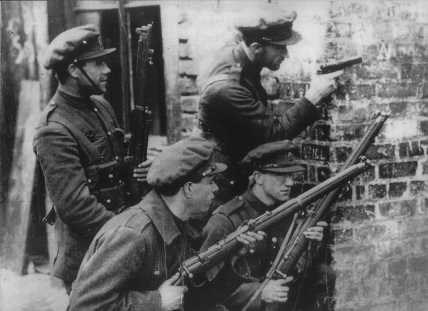
The Guard, along with other units of the Free State military, soon found themselves in donated British Army uniforms (dyed green), British-supplied weapons and equipment, and often British-style formations. As the conflict progressed thousands of ‘demobbed’ soldiers from the British Forces (particularly the so-called Irish regiments disbanded as a result of the Treaty) became a prime target for Free State recruiters, and whole battalions of the INA were composed of ex-British soldiers, RIC men and in some notorious cases ex-Black and Tans. Even the IRB-dominated Dublin Guard was not immune to British influence and it membership swelled with former soldiers of the Royal Dublin Fusiliers (some of whom had fought in the Easter Rising and War of Independence – on the British side). This in part accounts for the later ferocity of the Free State’s war machine when it was fully unleashed on its Republican opponents and undermines the old myth of the Civil War as a simple and tragic brother-against-brother narrative.
On the other side of the approaching conflict the two anti-Treaty IRA groups were soon reunited, and the Irish Republican Army quickly outnumbered its INA splinter by a ratio of three-to-one. It retained the majority of the Army’s combat veterans, the majority of its most experienced officers and just as importantly significant numbers of younger Volunteers. Indeed there was a noticeable experience and generation gap between the IRA and INA. In contrast to the IRA the INA attracted mainly non-combat staff officers or those from uninvolved areas, as well as those closely associated with the Dublin GHQ, with a noticeable tendency towards older men.
However the IRA’s greatest weakness was, as always, its lack of arms and equipment. During the Truce, though some quantities of munitions had been smuggled into the country (and many weapons abandoned, or stolen or bought from the departing British forces), most units remained under-equipped. In the ‘official’ arms importations organised or sanctioned by the GHQ a bias had been given to re-equipping those units thought to be closest to the thinking of the GHQ Staff in Dublin. So the Anti-Treaty IRA entered the conflict with a far poorer stock of weapons and equipment compared to Pro-Treaty forces which were able to draw upon the military resources of the British Empire.
In some ways the split in the Irish Republican Army, and the subsequent civil war, had already seen a dry-run in the division of the original Irish paramilitary organisation from which the IRA had evolved. Formed in 1913 as the Irish Volunteers (or Irish Volunteer Force), this nationalistic militia was created to force or defend the implementation of British-legislated Home Rule in Ireland, which predictably never emerged. It eventually split in 1915 along rival political lines between Irish Nationalists and Irish Republicans (whereas the majority who split off in 1915 were Nationalists, in 1922 the Nationalist splitters were a small minority, a sign of just how far politics in Ireland had progressed). In the aftermath of the 1915 division in the original Irish Volunteers, the breakaway and newly titled Irish National Volunteers (INV) entered a period of uneasy cold war with their former comrades that at times broke out into open violence, an animosity that only dissipated in the aftermath of the Easter Rising of 1916 (though in fact during the insurrection some INV units in Athlone, Wexford and other districts offered help to the British Forces to put down the insurrection, providing military escorts, ‘police’ patrols and scouts; these echoes of this original proto-civil war were to continue to sound in places like Limerick and parts of Ulster throughout the War of Independence and into the Civil War itself).
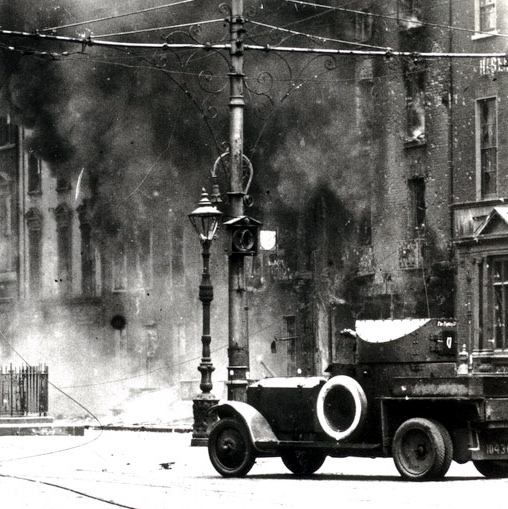
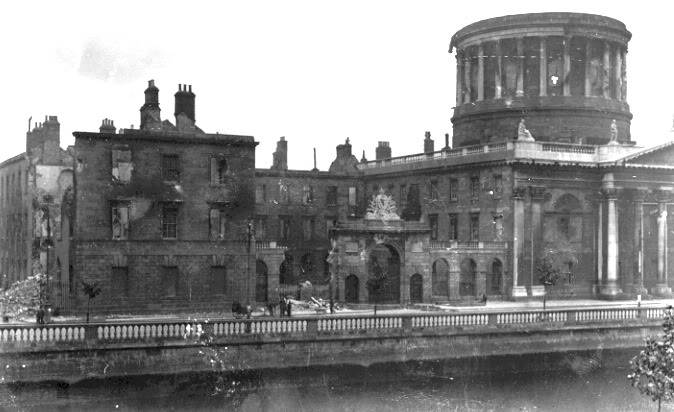
‘The Fall of Dublin’, and history, records that the opening salvos of the Civil War took place at the Four Courts on the 28th of June 1922 (though some in Kilkenny would claim that the first shots of the civil war were in fact fired in May 1922 when Pro- and Ant-Treaty IRA forces vied for control of the city; just as the people of Cork claim that the first actions of the War of Independence began with hold-ups and gun battles between the IRA and RIC in Cork in 1918, not Tipperary in 1919). However this was simply the culmination of a slow descent into an internecine conflict. In Dublin city the leadership of the Anti-Treaty IRA had set up their national headquarters as had of course their Pro-Treaty INA opponents and here, as Liz Gillis’ ably explains, the Civil War was both lost and won.
In some ways the 1922 Battle of Dublin could be described as a second 1916: poorly organised and led Republicans seizing various buildings and districts around the city centre of Dublin against a much larger, better led and equipped force. Indeed one of the accusations made by some Republicans in the aftermath of the Fall of Dublin was the use of British troops in the assaults on the Republican forces entrenched in the city. Certainly this is given some credence in a paragraph by Gillis describing a mutiny of Pro-Treaty soldiers at Portobello Barracks:
‘Frank Carney, supplies officer at the barracks, was ordered to hand over weapons and other materials that were to be used in the assault:
He was about to obey the order when he recognised the officer receiving them as a British officer from the Phoenix Park depot [the British Army HQ]. Realising it was an alliance with British against Republicans that he was being called upon to take action, he refused to comply and resigned. Several men resigned with him and all were placed under arrest.’
However there is little other evidence of direct involvement by the British Forces in the fighting, though British troops were kept at the ready in bases around the city to intervene if need be and the British provided the artillery, heavy machine guns and armoured vehicles that the Free State forces used to swing the battle in their favour. Further offers from the British including the use of warplanes to bomb and strafe Republican positions were rejected. But later in the war direct British military assistance, particularly from the Royal Navy, was accepted so perhaps British ‘advisers’ were present during the battles at the Four Courts and maybe elsewhere. Certainly as the war progressed the Free State army increasingly resembled a ‘demobbed’ British Army in Ireland.
Amongst the lesser known facts of the Civil War highlighted by Gillis is the re-emergence of the Irish Citizen Army (ICA) during the Battle of Dublin. Beginning life as the de facto military wing of the Labour movement in Ireland, it had participated in the Easter Rising of 1916 but found itself languishing in the aftermath of the insurrection with the death or imprisonment of its leading members. Most surviving ICA soldiers joined the IRA-proper (the Irish Volunteers) or other organisations leaving a skeletal structure behind. One of the few actions it participated in during the War of Independence on its own accord was a clash with British colonial police in Dublin during street protests which resulted in the death of a police officer. However the Truce of 1921 saw a re-founding of the organisation and a larger body of organised left wing (and armed) Republicans. Nearly 150 men and women from the ICA were present in the Irish Republican garrisons in the city and participated directly in the fighting. This, perhaps, is an indicator of how radicalised sections of the Irish population had become throughout the course of the Revolution, particularly on the political left.
Another indicator is the high number of women present in the Republican forces arraigned against those of the nascent Free State. With the Cumann na mBan (CnamB), the Irish Republican women’s organisation, voting against acceptance of the Treaty the movement was firmly in the Republican camp (a handful of pro-Treaty members split off to form a rival Cumann na Saoirse, most because of family ties) and it served a role in the Civil War even greater than the one it had served in the War of Independence (suffering far greater hardship too). Hundreds of women were imprisoned (frequently in horrendous conditions), many took part in prison protests, an unknown number suffered sexual assault, and many were permanently marked as social outcasts in the conservative and reactionary Free State.
What Liz Gillis brings to the fore, and which characterizes the Irish Civil War as a whole, is the clear reluctance of the Republican side to fight the conflict in the first place. This stands in marked contrast to the aggressive willingness of the Nationalist side to wage war against their former comrades, even at the behest of the British. Like the almost civil war between Nationalists and Republicans in the divisions of 1915 it was the Nationalists who were the most ready to turn to violence in opposition to their Republican rivals. In fact, it could be argued that the willingness of Irish Nationalists to engage in ‘Irish-on-Irish’ violence dates back to the era of Daniel O’Connell and his political descendants and that the ‘gun’ was introduced into Irish politics not by Republicans but by Nationalists – against their fellow Irishmen and women.
Arthur Griffith, whose supporters portrayed him as man of peace dragged to war against his will, was one of those eager for the civil war, believing it inevitable and even necessary. Others in the former government of the Irish Republic who now took up residence in the new Free State regime were just as willing to see former colleagues and supporters dealt with – by any means necessary. While the actions of military veterans like Collins or Mulcahy are at least explainable by their experiences during the struggle against the British the ruthlessness of civilians like Griffith, Cosgrave and O’Neill can only be seen in the light of a century-old Irish Nationalist tradition of using violence against political opponents: particularly those espousing Republican beliefs. It is a side of Irish politics that has been rarely examined as the revolutionary violence of Republicanism has drawn all the attention compared to the factional ‘constitutional’ violence of Nationalism.
The remarkably non-partisan ‘The Fall of Dublin’, though short in length, is packed with information, some little known, some surprising, making Liz Gillis a historian worth watching in the future. Like the other books already published in Mercier’s Civil War series it adds greatly to our understanding of this crucial and divisive period in our nation’s history and will perhaps encourage others to re-examine the divisions in Irish politics between Republicanism and Nationalism. Divisions, that like the Civil War itself, still manifest themselves to the present day.
Related articles
- The Myths Of Easter 1916 – And The Truth (ansionnachfionn.com)
- John Redmond And The Blood Sacrifice – For The British Empire (ansionnachfionn.com)
- Guns For Hire – From RIC To RUC (ansionnachfionn.com)
- Britain’s Irish Civil War (ansionnachfionn.com)
 AN SIONNACH FIONN
Hi,
fascinating, amazing, mind blowing stuff. Have to get my hands on that book.
Do you know about the british army artillery unit smuggled into northern Ireland (Newry) and brought to Dublin under cover of darkness to man the guns. Mortars were used at the Four Courts & Drogheda & Limerick (but the Free State forces did not possess mortars or competent personal to use them, mortars are very tricky things to use in urban warfare), so they must of been manned by British Troops. As for the 18 pounder field guns borrowed from the British Army, well evidence shows that they actually missed the Four Courts on a couple of occassions and nearly blew the shite out of the British Army HQ on Constitution Hill, so I’m not too sure that they were actually artillery personnel (you cant really miss using direct fire with an 18 pounder I fired them in the Irish Defence Forces in the 1970s).. I suspect that there was much more collusion with the British Forces than we see at present.
Again, thanks for some really marvelous attention to detail on this website.
Pat McMahon
LikeLike
Indeed, I touch upon these matters here. There is also the issue of co-operation with the British Navy during operations in Munster as well as the general interdiction of shipping to and from Ireland on behalf of the Free State regime.
LikeLike
What do you think the bottom line with Michael Collins was then Sionnach.? Was he pressured by the thoughts of a new re-invasion of Ireland.? Did he think that he could talk the Rebels round and wait out for a united Ireland. The Crown’s politicians would have been light years ahead of Collins/Dev et all. They possibly would even have been looking out at the threat of another World conflict..? Whatcha think.?
LikeLike
I believe he intended to make a “temporary little settlement” that he would soon have disavowed one way or another. Those who took the opposite view believed that he was mistaken, or miscalculated, and that the short-term would become long-term. They supported principle as well as real politik. Collins thought he could outwit everyone. I believe in the weeks leading up to his death he had come to realise that he was being sucked into a permanent Free State and partition arrangement by an alliance of the old regime of the Irish Parliamentary Party/United Irish League, the RC Church, Southern Unionism and the British. In part that is why he was reaching out peace-feelers to the Republican side, with the hope of arranging some sort of compromise that they could agree to (as well as bringing an end to the horror of the civil war itself).
With Collins off the scene any hope of a roll-back on the Treaty was gone and an agreed end to the Civil War was gone.
However, I admit I could be wrong. There are those who believe that Collins sold his soul to the devil when he went to war in Dublin over the Four Courts. There was no turning back then – nor did he intend to.
I suppose each person must make up their own mind on the historical evidence that we do have.
LikeLike
Very interesting read, leads me question my beliefs…again! …..must get the book!
LikeLike
I felt the same the more I looked into the whole civil war era.
LikeLike
Many thanks for bringing this book to the attention of a wider audience. I hope to have a look at it soon.
On the issue of ex-servicemen in the Free State Army, are their references for quotes like “whole battalions of the INA were composed of ex-British soldiers, RIC men and in some notorious cases ex-Black and Tans” ?
This is something which I have read in a number of different places but I haven’t been able to get sources for it and it doesn’t seem to make much sense, given that recruitment to the Free State Army was supposed to be confined to members of the pro-Treaty IRA up until the “Call to Arms”. That’s where the initial 7,000 strong INA is supposed to have come from. The Call to Arms wasn’t issued until the 6th July 1922. This was after the Battle of Dublin had already ended i.e. the Battle of Dublin was between anti-Treaty and pro-Treaty IRA members.
On the issue of ex-servicemen in the INA after the Call to Arms had issued, Peter Cottrell has gone so far as to suggest that up to 50% of the INA were ex-servicemen. However, the National Army Census of November 1922 (which is available online) indicates that the vast majority of the INA were just 22 years of age and under, which would suggest that they were too young to have ever been members of the British Army. Food for though.
Thanks again.
MGDT
LikeLike
Will dig up a few book/internet references for you. Had them at the time of the review so will look through them when I get a mo. There is one particular unit I saw referenced.
Certainly the INA post summer-1922 was heavily ex-British military/paramilitary though not as great as Republican claims at the time.
LikeLike
There was nothing wrong with the Royal Dublin Fusiliers, Connaughts, Munsters etc. They were Irishmen and Catholic. Many following RDF disbandment in 1921/22 would have needed a job an then automatically transferred to the Free State Army or An Garda Siochana. That should not have been a surprising fact. Theefore to say that the RDF had “British influence” is really inaccurate. I could not imagine the ordinary, below-poverty line Dubliner, like my own relatives at that time, engaging in espionage within the INA. Thank you.
LikeLike
https://polldaddy.com/js/rating/rating.jsYour lack of respect or even discretion when it comes to Irishmen (mostly Catholics) who found themselves confronting their fellow Irishmen is very disheartening. The Royal Dublin Fusiliers for example were waiting to be posted to France they were, according to sources, dispatched to deal with a disturbance. Irish society at that time was highly complex and people like yourselfes would benefit and do well to comprehend that. I do read other articles by yourselves which are of a high accurate standard. When it comes to the RDF, Munster Fusiliers, Irish Regiment , National Army, RIC, & DMP there is severe lack of empathy or understanding for the situation them. As for imperialism, men who joined the BA didn’t necessarily even know what imperialism was or look at it from that perspective. My great uncles (one in the AOH) & great grandfather were in the Inniskillings(Sgt Thomas Patrick Donnelly from Fintona Tyrone). They were Nationalist/ home rule in outlook and according to older relatives were bitter about the Famine for instance. Thank you.
LikeLike