
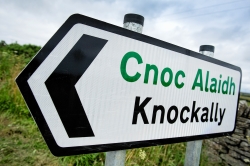
It says much, perhaps, for the power of colonialism that so many inhabitants of so many colonised or formerly colonised nations deprecate their own indigenous languages and cultures in favour of that of the coloniser. Ireland of course is one well know example, perhaps indeed the prime example, certainly in a European context. The number of Irish people who hate any form of a “native” Irish identity is quite extraordinary. It is like a personal affront to them and they greet it with much the same racist attitudes that our former colonial masters expressed in times past – and often the same language and levels of intimidation too. The Pale mentality is an ever-present and festering infection in modern Irish society.
Scotland, our Gaelic sister nation, has yet to enter the “post-colonial” period we are in (allegedly in). However that may all change come the independence referendum (notwithstanding the claimed Jubilee and Olympics driven “feel good” British nationalism sweeping the island of Britain). Like us Scotland has its Anglophone supremacists, those who scream the loudest that all that is indigenous to Scotland, language, culture (communities?) is beyond the Pale (as it were). The arguments seem all too familiar to anyone from Ireland (or Africa, the Americas, Australasia, and so and so forth).
In Scotland the Anglophones can’t even stomach the sight of the Scottish language appearing on their road signs (though Ireland is not much better). From the John O’Groat Journal:
“A CAITHNESS councillor yesterday hit out at the cost of installing bilingual road signs in the far north and described the move as “the height of nonsense”.
Thurso representative John Rosie said “thousands of pounds” will be spent on the controversial road signs and claimed the money would be better spent on front-line services and filling potholes.
He spoke out after what is believed to be the county’s first bilingual Gaelic and English road sign was installed at Knockally on the Braemore road near Dunbeath.
Mr Rosie, a vociferous opponent of the Highland Council policy, said putting up the signs is “the greatest waste of money. It is hard to think of a greater waste of money.
“They are no use to the average man in the street or to visitors as it is only Gaelic speakers who can understand them.”
His Thurso colleague, Donnie Mackay, agreed. “It makes me mad. We have been waiting for nine years to get street signs in Thurso,” he said.
In 2008, eight Caithness councillors put forward a motion that bilingual signs in the far north should be restricted to the Ord of Caithness, the towns of Thurso and Wick and John O’Groats. But the move was defeated by 50 votes to 12 in favour of a policy that Highland Council reaffirm its commitment to the Gaelic Language Plan.”
Are Gaelic speakers, the speakers of the Scottish language, not the average man in the street too? Or is it only English speakers that deserve recognition as “people”?
What are Scottish speakers then? Untermenschen?
And the entirely artificial name of Knockally is easier to understand for visitors, including non-English speaking visitors, than the original Cnoc Alaidh? Seriously? Like, seriously?
I don’t think logic has anything to do with this. But it is perfectly obvious what does…
Meanwhile Scottish-speaking children have displayed the cognitive benefits of bilingualism in a new study featured in Health24:
“Bilingual children outperform children who speak only one language in problem-solving skills and creative thinking, according to research led at the University of Strathclyde.
A study of primary school pupils who spoke English or Italian- half of whom also spoke Gaelic or Sardinian- found that the bilingual children were significantly more successful in the tasks set for them. The Gaelic-speaking children were, in turn, more successful than the Sardinian speakers.
The differences were linked to the mental alertness required to switch between languages, which could develop skills useful in other types of thinking. The further advantage for Gaelic-speaking children may have been due to the formal teaching of the language and its extensive literature. In contrast, Sardinian is not widely taught in schools on the Italian island and has a largely oral tradition, which means there is currently no standardised form of the language.
Dr Fraser Lauchlan, an Honorary Lecturer at the University of Strathclyde’s School of Psychological Sciences & Health, led the research. It was conducted with colleagues at the University of Cagliari in Sardinia, where he is a Visiting Professor. Dr Lauchlan said: “Bilingualism is now largely seen as being beneficial to children but there remains a view that it can be confusing, and so potentially detrimental to them.
“Our study has found that it can have demonstrable benefits, not only in language but in arithmetic, problem solving and enabling children to think creatively. We also assessed the children’s vocabulary, not so much for their knowledge of words as their understanding of them. Again, there was a marked difference in the level of detail and richness in description from the bilingual pupils.”
Wow. Better not start putting up those bilingual signs. It might start making the citizenry smarter. And no politician wants that.
Related articles
- Kicking The Pale Where It Hurts (ansionnachfionn.com)
- Bravetongue (ansionnachfionn.com)
 AN SIONNACH FIONN
Very interesting article Séamas, It seems the North is not the only place with a paranoia about Language
LikeLike
Indeed not. Scotland and Wales have exactly the same language debates as Ireland, and often with the exact same phrases and terms of abuse or ridicule. Scotland in particular, due to the very weak state of the Scottish speaking communities and the Highland/Lowland, Catholic/Protestant, Nationalist/Unionist divides, can see a lot of trouble in relation to this issue. Even the SNP divides internally over it though Alex Salmond’s decision to make Scottish Gaelic a “tír gan teanga, tír gan anam” issue has led to a huge investment recently in education and infrastructure, not to mention a Gaelic Language Act which is transforming Scottish government affairs.
Like a single Scottish police force the SNP leadership see Scottish Gaelic as a way of differentiating Scotland from England. A distinct and separate nation must have a distinct and separate language.
LikeLike
Indeed. We also have the Scots language, a sister language to English that the UK recognises as a regional language under EU law. Whilst the Scottish government has taken some steps (at least since the SNP got in in 2007) to preserve and promote Scotlands other native tongue, It remains absent from the television and the airways, with most Scots ignorant that it’s even a language, and many of its speakers ashamed to speak it. I hope we can change things post independence, I don’t want to see my culture disappear down the Anglo-American drain!
Nice blog, just discovered it today but I’m going to enjoy reading it over the weekend. Thank you!
LikeLike
True enough, Rebecca. While some argue that Scots is simply a dialect of English I believe it has evolved enough from its origins to qualify as a distinct form of a Germanic tongue. I would say that modern Scots is to English, what Frisian is to English. And no one regards Frisian as a regional English dialect.
Though I naturally tend to favour Scottish (Scottish Gaelic) I agree that Scots needs its protection and promotion too.
Thanks for taking the time to Comment 🙂
LikeLike