
The Irish blogger “Endgame In Ulster” asks why is the political establishment of the British Unionist community in the north-east of Ireland in crisis? The answers make it obvious.

Irish News, Politics, Culture
The Irish blogger “Endgame In Ulster” asks why is the political establishment of the British Unionist community in the north-east of Ireland in crisis? The answers make it obvious.
 AN SIONNACH FIONN
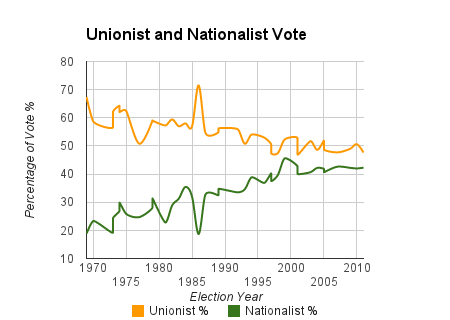
Interesting …but not for the reason I expected. In the second graph it seems the Nationalist vote has barely increased since about 1998. In the first graph it seems the Catholic population is increasing at a much slower and smaller incline than I expected whilst the Protestant population seems to be decreasing faster.
… and what happened in c1985?!
LikeLike
Yes, there has been an observable slow down in the Nationalist (Catholic) figures. Several factors at play here, not least more liberal views on contraception, abortion, etc. (and greater availability) in the Nationalist community. Considerable movement of members of the Nationalist community within Ireland as a whole and emigration overseas. These effect the overall numbers and the Nationalist vote which result from that. There is also growing apathy in the electorate that spans both communities (as all of the Western world). One must also allow for some Catholics voting Pro-Union (Alliance Party, etc.) or status quo parties (the Green Party is an All-Ireland one but sort of small “u” Unionist in the north-east of the country in that it has no official position on the border as such).
The fall in the Unionist (mainly Protestant) population is largely due to (much) lower birth rates, a (much) higher age profile, significant emigration to Britain, Canada, Australia, New Zealand, etc. This effects the Unionist/Pro-Union vote along with a (much) higher level of none-voting.
However slower change does not mean no change. The trends continue and there seems little reason why they should change over the next decade. Bangordub and others suggest the possibility of renewed acceleration as new voters come on to the electoral rolls (majority Catholic) and greater Unionist emigration.
LikeLike
Just a guess, but I think the spike in Unionist votes around 1985 was likely tied to the revulsion in those quarters at the Anglo-Irish Agreement.
LikeLike
Sounds likely. There was an unusually high voter turnout around that time that has noticeably fallen off since then, with Unionist scoring some of their highest votes in recent times.
LikeLike