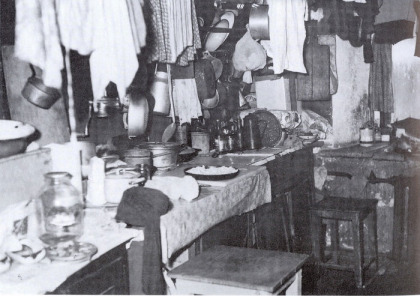
One never ceases to be staggered by the lengths to which the Soviet Union went to in order to oppress its citizenry.
In the decades following the 1917 Russian Revolution, among myriad other indignities heaped upon the Russian populace, Soviet leaders embarked upon a concerted effort to root out, of all things, individual kitchens.
Soviet authorities considered kitchens and private apartments a threat to the regime because they were places people could gather to talk about politics, according to National Public Radio.
The kitchen represented something bourgeois, said Alexander Genis, a Russian writer and radio journalist.
“Every family, as long as they have a kitchen, they have some part of their private life and private property,” he said.
The effort to eliminate private kitchens was facilitated by the rapid urbanization that took place in the Soviet Union following the end of World War I, due in no small part…

 AN SIONNACH FIONN
One never ceases to be staggered by the lengths to which the Soviet Union went to in order to oppress its citizenry.
In the decades following the 1917 Russian Revolution, among myriad other indignities heaped upon the Russian populace, Soviet leaders embarked upon a concerted effort to root out, of all things, individual kitchens.
Soviet authorities considered kitchens and private apartments a threat to the regime because they were places people could gather to talk about politics, according to National Public Radio.
The kitchen represented something bourgeois, said Alexander Genis, a Russian writer and radio journalist.
“Every family, as long as they have a kitchen, they have some part of their private life and private property,” he said.
The effort to eliminate private kitchens was facilitated by the rapid urbanization that took place in the Soviet Union following the end of World War I, due in no small part…
View original post 374 more words
Share